





Read this guide inEnglishEspañolFrançais
Exclusive Area Guide
Playacar
Fase 1
The first fraccionamiento in Playa del Carmen. Individually titled lots under a jungle canopy, one gate from Quinta Avenida and one step from the Caribbean, run by the owners themselves.
Lots, not units
Playacar Fase 1 is the original, seaward half of Playacar, immediately south of the ferry pier in Playa del Carmen. It is a fraccionamiento: land was subdivided into private lots, each with its own title and its own street frontage. That single legal fact is what separates it from Playacar Fase 2, where most of what is for sale is a unit inside a condominium regime with a shared building and a shared administration.
The effect on the ground is visible from the air. Fase 1 is houses under trees, at low density, on curved streets that dead end rather than connect, with the beach on one side and the town wall of hotels and Quinta Avenida on the other. Buildings are low, the canopy is taller than most roofs, and there is no through traffic because there is nowhere to pass through to.
You own the land
Individual lot titles rather than percentage shares of a building.
Owner run security
A single controlled entrance, with the gatehouse and patrols paid for by the owners through the association.
Low density and canopy
Few levels, deep setbacks and mature jungle between the houses.
Walk to town
Quinta Avenida, the ferry to Cozumel and the beach clubs are minutes on foot.

How the first fraccionamiento was made
Playa del Carmen was a fishing town and a ferry stop for most of the twentieth century. Playacar is the project that turned it into a destination, and Fase 1 is the part that was drawn first.
The coast here was a pre Hispanic port town, the point of departure for the pilgrimage crossing to Cozumel. Its remains sit inside the fraccionamiento today: a group of small structures along Paseo Xaman-Há, protected by INAH, with houses and gardens built around them rather than over them.
Playacar is conceived in the 1980s as a single tourist and residential development on the coast south of the town, split into two phases with different purposes. Fase 1, closest to the sea and to the town, is planned as the low density residential half, with strict rules from the start to protect vegetation and privacy.
The residential lots are titled and the first houses go up, in the Mexican Caribbean vernacular of the period: white masonry, terracotta tile roofs, palapas, arches, deep terraces. The 18 hole course designed by Robert von Hagge opens in 1994 on the inland side, in what becomes Fase 2, and the Xaman-Há aviary opens on that side as part of the development’s conservation commitment.
The all inclusive resorts, the condominium towers and Plaza Playacar are built inland, in Fase 2. Fase 1 stays what it was drawn to be, which is why it has the older trees, the larger lots and almost none of the mid rise product that defines the rest of Playacar.
There is no more land to subdivide. What changes hands is either an original 1990s villa to be renovated or replaced, one of the very few remaining vacant lots, or a unit in one of the small low rise buildings inserted on a corner lot. That scarcity, inside a gated perimeter five minutes from Quinta Avenida, is the whole investment case.

Not a condominium. An organised community.
This is the part buyers from the United States and Canada most often get wrong, because there is no exact equivalent at home. Fase 1 is neither a municipal neighbourhood with city services nor a condominium with a building administrator. It is a subdivision whose owners organised themselves to run the common parts.
What you buy
A lot and the construction on it, titled in your name, or through a fideicomiso if you are foreign.
- Escritura for the individual lot
- No indiviso, no shared building
- Predial paid on your own property
- Freedom to rebuild inside the rules
What the association runs
The owners’ association maintains everything between the lots and controls who comes in.
- Gatehouses and 24 hour access control
- Patrols inside the perimeter
- Street lighting, paving and signage
- Green areas, canopy and pruning
- Rubbish collection and street cleaning
What it costs you
An annual or quarterly maintenance fee per lot, set and voted by the owners.
- Fee scaled to lot size, not to a unit
- Assemblies and an elected board
- Design review before you build
- Fines and access sanctions for breaches

Before you make an offer, ask us for three documents: the current association fee and what it covers, the internal building and coexistence rules that apply to that specific lot, and a letter confirming the seller has no outstanding fees. In a fraccionamiento these are the equivalent of reading a condominium’s minutes, and they are just as revealing.
What living here is actually like
The trade Fase 1 offers is unusual: the quiet of a gated low density enclave, with a walkable town centre on the other side of the gate. Very few beachfront addresses in the Riviera Maya let you leave the car parked for a week.
The beach
The stretch in front of Fase 1 is one of the calmest in Playa del Carmen because there is no public land access through the fraccionamiento.
- Wide sand, no beach club noise
- Reef offshore and Cozumel on the horizon
- Sargassum cleaning crews work the season
- Beach clubs and Mamitas ten minutes north on foot
Inside the gates
The green infrastructure is part of the product, and it is maintained rather than decorative.
- Xaman-Há archaeological site along Paseo Xaman-Há
- Xaman-Há aviary in Fase 2, a conservation collection of regional birds
- Walking and cycling paths under canopy
- Tennis, and golf access through the club in Fase 2
Day to day services
Everything routine is inside Playacar or within a few minutes of the gate.
- Plaza Playacar in Fase 2: supermarket, pharmacy, gym, restaurants
- Hospiten and private clinics nearby
- Two international schools in Playacar
- Sam’s Club and Chedraui Selecto minutes away
Eating and evenings
Quinta Avenida is the restaurant strip, and the good tables are a walk rather than a drive.
- Quinta Avenida from Calle 1 Sur northwards
- Playacar beachfront restaurants and hotel dining
- Calle 38 and the north end for quieter kitchens
- Cozumel by ferry for a day, from the pier at the gate

What might put you off
Sargassum has a season
Between roughly April and August the Caribbean brings sargassum ashore in variable quantities. Crews clean the Playacar beach daily and some years are far worse than others, but nobody should buy beachfront on this coast without accepting it as part of the calendar.

Electricity is not cheap, and there is an answer
A villa with air conditioning and a pool moves onto the high consumption CFE tariff quickly, so ask for the last twelve months of bills rather than the winter average. The fix is already standard here: Playa del Carmen has a long list of solar installers, panel prices keep falling, net metering with CFE lets you bank what you generate, and roof arrays are going up all over Playacar. Most owners who solve it once stop thinking about the bill.

Most stock is thirty years old
The architecture that gives Fase 1 its character comes with 1990s wiring, plumbing, glazing and roofs. Very few houses here are turnkey by North American standards, and a renovation in Playacar runs on the association calendar and the municipal permit queue.
Town noise on the north edge
The lots nearest Calle 1 Sur are the most walkable and also the closest to the loudest part of Quinta Avenida. Two streets in makes a real difference, and it is worth visiting a candidate lot after dark before you commit.
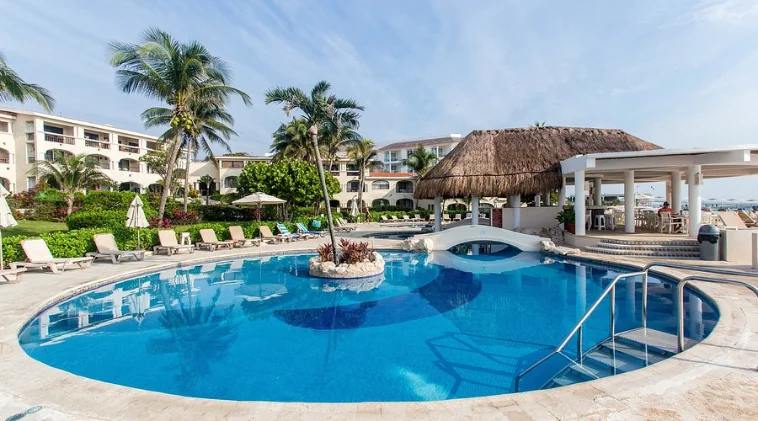
Playacar Fase 1 in photographs


What you are allowed to build
Most of what sells in Fase 1 is bought to be rebuilt or heavily renovated, so this is the section that decides whether a lot is worth its price. Two rulebooks apply at the same time, and the stricter of the two always wins.
The municipal rulebook
Playa del Carmen’s urban development programme sets the land use, density, ground occupancy and height for each polygon. In the coastal low density zones that cover Playacar the ceiling has historically been a handful of levels, measured from the level of the street to the parapet or ridge, with mandatory setbacks and a minimum of permeable, planted surface per lot.
The association rulebook
The Playacar internal regulations go further than the municipality: approved roof types and materials, colour palette, wall and fence heights, pool and equipment placement, protection of existing trees, working hours and a construction bond. Your architect submits the project to the association before it goes to the city.
What changed in 2026
Both instruments have been rewritten. The municipal construction regulation, unchanged since 2007, went through a full update proposal in early 2026 covering permits, site safety, working hours and technical annexes, and the new urban development programme for Playa del Carmen, which is the document that actually sets heights and densities, was still in its consultation and urban congruence stage during 2026. Nothing is final until it is published.
Why it matters to a buyer
A vacant lot or a teardown is only worth what the rules will let you put on it. Before you commit, we obtain the current land use certificate for that exact lot, the association’s design criteria, and confirmation of what is in force the day you sign, not what a listing claims.

The permitting sequence, in order. Land use certificate from the municipality, then association design approval, then the construction licence with stamped structural and architectural drawings, then connections and, at the end, the occupancy sign off. Work on site is restricted to weekday daytime hours and Saturday mornings, and neighbours in Playacar do report violations. Budget the calendar as carefully as the build: in this fraccionamiento the paperwork is rarely the fast part.
What you can actually buy here
Inventory in Fase 1 is thin by definition: one entrance, a finished perimeter, no new land and owners who tend to hold. The prices below are floors, not averages: each one is the cheapest thing of its kind we currently see, and the typical listing in every category sits above it.
Rare. Condominiums almost never come to market in Fase 1, and the ones that do are old. At this figure you are looking at a one bedroom.

The core of the fraccionamiento. Detached houses on their own lots, three to five bedrooms, pool, mature garden, often 1990s construction with the good bones and the dated systems that come with it.
The scarcest thing in Playa del Carmen: a titled lot on the sand inside a gated perimeter, walking distance from Quinta Avenida. A handful of properties, sold rarely, with the top of the range well past this figure.
Illustrative rental returns
| Property type | Entry price | Typical occupancy | Est. gross yield |
|---|---|---|---|
| Villa or residence | USD 900,000 | 55 to 70% | 4 to 6% |
| Beachfront villa | USD 2,000,000 | 50 to 65% | 3 to 5% |
Illustrative figures for comparison between property types, based on occupancy ranges reported for vacation rentals in Playa del Carmen and assuming rental is permitted for that lot. Gross yield before management, association fees, tax and insurance. Villas in this segment are usually bought for use first and yield second. We prepare a specific projection for any property you are considering.
Before you buy: the rules that change the numbers
Rental is decided lot by lot
Vacation rental happens in Fase 1, but access control, guest registration and quiet hours are enforced, and the internal rules that apply to your street may be more restrictive than the listing suggests. Confirm it in writing before you underwrite rental income.
You buy through a bank trust
Playacar is inside the restricted coastal zone, so foreign buyers hold title through a fideicomiso: full ownership rights, a renewable term and an annual bank fee to budget for. A Mexican company is the alternative for commercial use.
Association fees and arrears
The fee is per lot and voted by the owners, so it moves. Ask for the current amount, the last assembly’s minutes and a no debt letter, because unpaid fees follow the property, not the seller.
Age is the real variable
Two villas on the same street can be twenty years apart in wiring, plumbing, glazing and roof. In a market where most stock dates from the 1990s, the renovation budget, not the asking price, is what decides whether a deal is good.
Sending your money from the US or Canada
Funds move by international wire from your bank to the notary or to the developer trust account, never in cash. Plan two to four business days, a currency conversion that is usually better through a specialist exchange house than through a retail bank, and the source of funds paperwork that both your bank and the notary will ask for. See financing and payment options.
What it costs a US or Canadian buyer
The whole budget on one page. These are the real line items and the ranges we see, not a quote: every figure moves with the assessed value and the exchange rate.
| Line item | Typical range | What it is |
|---|---|---|
| At closing, oncePaid by the buyer. Total 7% to 10% of the price. | ||
| Acquisition tax (ISAI) | ~4% of assessed value | State transfer tax |
| Notary, registry, certificates | 1.5% to 2.5% | Deed closed and filed by the notario |
| Fideicomiso set up + SRE permit | USD 1,000 to 2,500 | Bank trust for foreign buyers |
| Appraisal, first trust fee, escrow | USD 1,000 to 3,000 | Bank and closing services |
| Broker commission | USD 0 | Paid by the seller |
| Every year you own itThe line that surprises North Americans most is the first one. | ||
| Predial (property tax) | Low, a fraction of US or Canadian tax | Cadastral value at a very low rate, discount in January |
| Fideicomiso annual fee | USD 500 to 900 | Charged by the trustee bank |
| Association maintenance fee | Per lot, voted by owners | We get the current figure for your lot |
| Electricity, water, internet | Varies widely | AC and pool are the variable. Solar solves it |
| Insurance | On construction value | Hurricane and contents. Not optional on the coast |
| Gardener, housekeeper, pool | Optional | Inexpensive by US or Canadian standards |
| If you rent it, and when you sellSet the Mexican side up before the first guest. | ||
| Rental income tax | ISR, plus IVA on short stays | Register with SAT. Platforms withhold at source |
| Capital gains on sale | ISR on the gain in pesos | Exchange rate matters. Invoice every renovation |
| Reporting at home | T1135 for Canadians | US: the IRS does not treat a fideicomiso as a foreign trust |
| Timeline of a purchase | 6 to 12 weeks | Offer, promissory, trust permit, closing. Usually cash |
We are not your accountant and this is not tax advice. It is the checklist we walk every foreign buyer through, and we put you in front of a notary and a cross border accountant before you sign. See financing and payment options.
The neighbours, and how you get out
Fase 1 has one controlled entrance and sits between the town centre and the resort half of Playacar. What surrounds it is as relevant to value as what is inside the gate.
The gate at Calle 1 Sur opens onto the south end of Quinta Avenida, the pedestrian street that runs the length of the town, and onto the Cozumel ferry pier. This is why Fase 1 is walkable in a way that no other gated beachfront community on this coast is.
On foot · Restaurants · Ferry
The larger, later half: the golf course, the all inclusive resorts, the condominium towers, Plaza Playacar, the schools and the medical services. Residents of Fase 1 use Fase 2 daily for shopping and services. See the Playacar Fase 2 guide.
2 min by car · Golf · Services
Past Playacar the coast turns into the park and hotel corridor: Xcaret, Occidental at Xcaret, Puerto Aventuras and the cenote belt inland. All of it is reached from the Federal 307 without crossing town.
10 to 25 min · Parks · Cenotes
The highway is the spine of the Riviera Maya. Playacar’s own access avoids the town’s worst intersections, and the Tren Maya station at Playa del Carmen puts Cancún, Valladolid and Tulum on a rail connection rather than a drive.
5 min · Highway · Rail
The luxury resort and golf corridor begins ten minutes north at Mayakoba and continues through Puerto Morelos to Cancún and its airport. It is the comparison set for beachfront pricing on this coast.
10 to 50 min · Golf · Airport
Forty five minutes by ferry from the pier at the gate, and the reason this shoreline exists: the island reef system is the second largest in the world and the diving is what first brought foreign buyers to Playa del Carmen.
45 min by ferry · Diving
Five minutes from everything, behind a gate
Playacar Fase 1 occupies the coast immediately south of the Cozumel ferry pier and runs inland to the boundary with Fase 2. Paseo Xaman-Há is the spine, and the archaeological site sits along it.
Which street you buy on changes your daily life more than the house does: the beach row for the sea, the interior streets for canopy and quiet, and the northern edge for the shortest walk into town.
The two phases meet along Paseo Xaman-Há, the avenue that runs south from the entrance. Everything between it and the sea is Fase 1; everything on the inland side, wrapping the golf course, is Fase 2. You cross from one to the other without leaving the fraccionamiento, which is why residents of Fase 1 use the plaza, the schools and the clinic in Fase 2 as if they were their own.
Interactive map · the Playacar Fase 1 perimeter and where it meets Fase 2 along Paseo Xaman-Há

Reasons to choose Playacar Fase 1
Land, inside a gate, in a finished perimeter
You own titled land rather than a share of a building, in an enclave that cannot grow. Everything new here replaces something old, which is the strongest argument there is for holding value.
Walkable beachfront is almost unique
Gated beachfront communities on this coast are usually a drive from anything. Fase 1 puts Quinta Avenida, the ferry and hundreds of restaurants five minutes outside the gate, which widens the buyer pool every time you sell.
You control the asset
Because it is not a condominium, you decide when to renovate, rebuild or extend, within the municipal and association rules. Nobody else’s assembly vote determines the quality of your building.
Low density is written into the plan
Heights, setbacks and planted surface are regulated by both the municipality and the association. The canopy and the privacy that make Fase 1 worth its premium are protected by rules, not by luck.
Property tax barely registers
In most of the world an oceanfront house is punished every year by property tax. Here the predial is assessed on cadastral value at a very low rate, so annual holding costs on a beachfront home in Mexico are a fraction of what the same house would cost you in Florida, California or Ontario. That single line item changes the maths of owning for the long term.
Dollar priced, peso costs
Sale prices and rents are quoted in dollars while maintenance, staff and services are paid in pesos, a natural hedge for foreign owners.
The market around it keeps deepening
Playa del Carmen is still the fastest growing city on this coast, and the rail station, the airport road and the resort corridor north and south all add demand to a supply that is fixed.

Is it a condominium?
No. It is a fraccionamiento of individually titled lots, run by an owners’ association that maintains the streets, the green areas and the gatehouses through a maintenance fee.
Can I build a new house?
Yes, within the municipal parameters for the coastal low density zone and the association’s design rules. Both approvals are needed, and both were being updated during 2026.
Can I rent it out?
Vacation rental exists here, but it is governed by the association’s rules and access control, and it varies by street. We confirm it in writing for the specific lot.
Is the beach private?
No beach in Mexico is private, but there is no public land access through the fraccionamiento, so the sand in front of Fase 1 stays quiet.
What are the closing costs?
Plan on 7% to 10% of the price: acquisition tax, notary and registry, the fideicomiso set up and the SRE permit. The seller pays the broker.
What is the property tax?
The predial is assessed on cadastral value at a very low rate, so annual holding cost on a beachfront home here is a fraction of the equivalent in Florida, California or Ontario.
What about sargassum?
It has a season, roughly April to August, and it varies year to year. Crews clean the Playacar beach daily. Anyone buying beachfront on this coast should budget for it as part of the calendar.
More questions before you buy? Read our buyer FAQ.
Comparing communities? Condos around the golf course, next door: Playacar Fase 2. A newer master plan with golf and a beach club: Corasol.

Buying in Playacar Fase 1?
We will pull the land use certificate for the lot, the association’s rules and fee history, and tell you what can be built and rented there before you make an offer.
