




Read this guide inEnglishEspañol
Buyer guide 🇲🇽 For Mexicans and Mexican-Americans living in the US, Canada and Europe
Buying in the Riviera Maya
as a Mexican
who lives abroad
You live outside Mexico. Your assets do not have to. You built your life in another country, and that is where you earn, save and pay taxes. Mexico still gives you something a foreign buyer does not have: if you hold Mexican nationality, or can document it, you normally take title in your own name by direct deed, even on the coast. This guide explains how that works from the other side of the border.
Do I need a fideicomiso
if I am Mexican?
Normally no. The fideicomiso, the bank trust, is the instrument Mexican law requires of foreign nationals who acquire residential property inside the restricted zone, the 50 kilometre strip along the coast that contains all of the Riviera Maya. If you are Mexican and you buy in your own name, the property is acquired by direct deed and you appear as the owner at the Public Property Registry.
Living in Chicago, Toronto or Madrid does not make you a foreign buyer. What defines that is nationality, not where you live. There are exceptions that get reviewed case by case and we cover them below: a foreign spouse, co-owners, marital property regime, buying through a company, or requirements imposed by the bank financing you.

Two roads to
the same property
All of the Riviera Maya sits inside the restricted zone, and there the Constitution treats a foreign national differently from a Mexican one. A foreign buyer acquiring residential property in this strip normally needs a fideicomiso: a Mexican bank is named on the deed as trustee and the buyer holds the rights inside the trust. It works, it is safe, and it is what most foreign owners on this coast have, but it means a federal permit, a setup cost and an annual bank fee.
A Mexican national, wherever they live, normally skips that. The deed is granted in their name and recorded in their name. That is the saving almost nobody explains to you, and it is also why it pays to settle your Mexican paperwork first and the property second.
- 01Property
- 02Deed before a notary
- 03Mexican owner of record
Direct acquisition, recorded in your name, no trust and no annual trustee fee. You still pay acquisition tax, notary, registration and certificates.
- 01Property
- 02Bank trust, fideicomiso
- 03Foreign owner named in the trust
Permit from the Ministry of Foreign Affairs, trust setup and an annual bank fee, on top of the normal closing costs.
If you buy as a Mexican national, this page is your guide: you do not need the foreign-buyer route. What is worth reading is the step by step of the closing, document by document. And if your spouse is a foreign national or you are buying through a company, that is when the fideicomiso explained in depth matters.
Deed in your name
Direct acquisition like any Mexican buyer, on the coast included.
No annual trustee fee
There is no trust to set up and none to maintain year after year.
Access to Mexican credit
Mortgage products exist for Mexicans earning income abroad.
Inheritance and family
Planned with the notary at the deed, not afterwards.
If your husband or wife
is not Mexican
This is where “Mexicans do not need a fideicomiso” stops being automatic. If your spouse is a foreign national and the marital property regime means they can acquire a share of the property, the title structure gets decided before signing, not after. The same applies in these cases:
- The foreign spouse will be a co-owner or will appear on the deed
- Several people are buying together and one of them is a foreign national
- The purchase runs through a company, Mexican or foreign
- The mortgage imposes its own requirements about who can hold title and in what proportion
- Community property or separate property: the regime changes the outcome and is proven with documents, sometimes apostilled and translated
The person who determines the correct structure is the notario publico together with your attorney, with the documents in hand. Playa Realtors coordinates that review before the offer so the deed does not have to be redone.


Born outside Mexico
but Mexican family?
This is the conversation that repeats most with second and third generations. Born in the United States or Canada, raised hearing about Mexico at home, and assuming that here they count as foreigners. Often they do not, or they can stop being one with the right filing. There are three scenarios and it is worth placing yours before you look at property.
01 · Born in Mexico, living abroad
You are Mexican. Living abroad does not cancel your nationality, even if you acquired another one. What is usually missing is current documents.
- Mexican birth certificate, recent certified copy
- CURP, the national ID number used in almost every filing
- Valid Mexican passport
- RFC, the tax ID, essential if you are going to rent the property out
- ID: INE voter card or consular ID where it applies
- If you naturalized elsewhere, you are still Mexican under Mexican law
02 · Your mother or father is Mexican
The amendment to article 30 of the Constitution published on 17 May 2021 broadened this: people born abroad to a Mexican mother or a Mexican father are Mexican by birth.
- The text in force no longer requires that parent to have been born on Mexican soil
- There may be a right to nationality even if you have never lived in Mexico
- The usual path is registering the birth at the Mexican consulate that covers where you live
- It is proven with the document chain: your parent’s certificate, your foreign certificate, apostille and translation where required
- The registration produces a Mexican birth certificate, a CURP and eligibility for a passport
03 · Your grandparent was Mexican
Here we have to be exact: not every grandchild of a Mexican qualifies automatically. In several cases there is a generational path.
- First the nationality of the middle generation is documented, your mother or father
- Once that is established, the next generation may be in a position to document its own
- It all depends on the document chain and on the specific case
- In October 2025 a bill was introduced in Congress to expressly include grandchildren of Mexicans; as of this page’s date it is not constitutional text in force
- If your family kept old certificates, service records or passports, that file is worth gold
What we can actually do
Playa Realtors is a licensed brokerage in Quintana Roo. We are not a government office, we do not issue documents and we are not an immigration firm. What we do is identify which paperwork needs reviewing in your case and connect you with the right people: attorneys, filing specialists, accountants and consular documentation specialists, plus the notary who will handle your deed.
Why this comes first
Because the answer changes the entire purchase. If you document your Mexican nationality, you normally acquire by direct deed with no trust. If not, the purchase is still perfectly possible as a foreign buyer, with a fideicomiso, and then you budget the federal permit, the trust setup and the annual bank fee. Knowing from the start avoids rebuilding the file halfway through the transaction.
General information reviewed in September 2026 against the text in force of article 30 of the Political Constitution of the United Mexican States. Not legal advice. Requirements and procedures are set by the Ministry of Foreign Affairs, the consulates and the competent authorities, and they can change.
Official sourcesThe text of the Constitution in force, article 30 included, at the Chamber of Deputies. Nationality, passport and birth-registration procedures at the Ministry of Foreign Affairs. Programs and guidance for Mexicans abroad at the Institute for Mexicans Abroad. Tax registration and obligations at the Mexican tax authority.

Was your mother, father
or grandparent Mexican?
Tell us your situation. We help you identify which documents need reviewing and connect you with the right specialists, before you start looking at property. The consultation commits you to nothing.

Before you buy, we can help you
put your Mexican documents in order
This is not paperwork for its own sake. It is the difference between closing in forty-five days and waiting on a birth certificate that takes six weeks to arrive from another state. This is what we review with you at the start, and what we connect you to the right specialist for.
Birth registration
For anyone born abroad who may have a right to Mexican nationality. The usual filing is registration at the consulate that covers your address.
Mexican birth certificate
A recent, legible certified copy. If yours has errors in names or dates, they get corrected before the deed, not during it.
CURP
Used in practically every Mexican administrative filing. Worth verifying that yours exists and that the data matches your birth certificate: you can look it up and print it free at the official CURP portal.
Mexican passport
Mexicans abroad can obtain or renew one at Mexican consulates, by appointment through the MiConsulado system and under the requirements set by the Ministry of Foreign Affairs.
RFC, the tax ID
Increasingly present in real estate transactions and notarial filings. It is essential if you are going to rent. We connect you with accountants who handle the registration and what the tax authority asks for, including the e.firma digital signature when a filing requires it, which is not always.
INE card or consular ID
The INE card, the Mexican voter ID, is the identification that simplifies your life here the most, at the bank, in front of the notary and in any filing, and getting one is easier than people think: you book an appointment at the INE module finder. If you do not have it yet, the consular ID works in the meantime.
Power of attorney
For anyone who cannot travel at every stage. Certain acts can be handled with a properly drafted power, granted at a consulate or before a notary, subject to what the notary and the bank accept in your transaction.
Documents from another country
Marriage certificates, divorces, powers and court orders may need an apostille and a certified translation into Spanish, depending on the transaction and the notary’s criteria.

And if you are coming anyway, get the passport here. The Cancun office opens every day, weekends included, and with an appointment and all the requirements in hand the passport is issued the same day. Many of our clients get it done on the same trip they see property, and book the INE appointment while they are at it.
Proof of address is not your problem either. It is the sticking point for almost everyone: twenty years abroad and no utility bill in your name in Mexico. Do not stall there. We have filing specialists who do exactly this, who know which office asks for what, and who build the file with you from wherever you are. The advantage is not having more paperwork, it is having the right paperwork before the transaction depends on it: when the file is complete, the notary moves and the closing does not stall.
Living outside Mexico does not mean
you have to pay all cash
This is the most expensive belief in the whole conversation. A Mexican who lives and works abroad can have access to a Mexican mortgage even though the income is earned outside the country. It is not automatic and it is not for everyone: approval depends on your file and on the property. But it exists, and it is worth measuring before you decide you can only buy what you have in cash.
Approval is not decided by your nationality. It is decided by your file and by the property.
- Country where you live and where you will pay from
- Nationality and the Mexican documents available
- Employment, tenure and how income can be proven
- Income level and capacity to pay
- Credit history, abroad and in Mexico
- The property: the bank approves it too, not only you
- Amount requested and each institution’s current policies
Pre-approval first, viewings second. The approved amount defines the area and the type of property, and it keeps you from falling for something the bank will not finance. Run your numbers through the mortgage simulator before we talk, and you arrive at the first call with a figure in hand.
We have access to the mortgage brokers in this area, so you are not stuck at one bank’s counter.
One example of what exists today for Mexicans working in the United States, not an ad and not an offer:
- BBVA Mexico offers “Tu Opcion Mexico”, aimed at Mexicans working in the United States
- Fixed rate, with the loan denominated in Mexican pesos
- Financing of up to 90% of the home value depending on the case and the product; in other scenarios the published maximum is lower
- Income earned in the United States is documented with pay stubs, W2, tax transcript or bank statements depending on your type of work
- US or Mexican credit history may be considered
- Payments can be made from abroad
- Life and property insurance are mandatory with the loan
That is one product, not the only one. We put your case in front of several brokers and banks in this area and tell you who actually lends to someone with your profile, your kind of income documentation and the property you want. Terms, rates, total annual cost and requirements are published and changed by each bank: BBVA reports a total-annual-cost calculation dated 30 June 2026 with the offer valid to 27 December 2026, subject to credit approval, consulted September 2026.
If you live in Canada, Europe or elsewhere, the answer is more specific and depends on the lender.
- Some Mexican institutions assess Mexicans living outside the United States case by case
- The other route is financing where you live and buying with cash in Mexico
- A mortgage broker helps you compare institutions instead of knocking on one door
- We connect you with mortgage specialists to assess your actual case before you run the numbers
We do not promise credit. We promise you will know clearly whether you have it and how much, before you make an offer.
The other route is not borrowing in Mexico at all, but using the equity you already built in the United States.
- A home equity line of credit on your US house, so you pay cash here and owe your bank there
- A cash-out refinance, if your current rate makes that sensible
- A loan against your 401k, which is not the same as a withdrawal: an early withdrawal can carry a penalty and withholding, while a loan is repaid to yourself under your plan rules
- A personal or credit union loan to cover the gap
- The real advantage: in this market a cash buyer sees inventory a financed buyer never sees, and negotiates differently
Each one has a cost and a risk. You are putting your US house or your retirement behind a purchase in Mexico, so the number gets modelled with your accountant or financial advisor first, not after. We tell you how much you need and for which area.

Want to see the monthly payment before asking a bank for anything? Use the mortgage simulator: enter the amount, the term and the down payment, and it returns an estimate. It is an estimate, not a pre-approval and not an offer. And to know what figure you are playing with, look at house prices across the whole area, from downtown Playa del Carmen to Tulum and Cancun, or the general search if condos and land interest you: real inventory with price, square metres and location, not ranges.
The Mexican mortgage market is active
This is not a market without capital or a system closed to people who live abroad. Mexican banks keep committing serious capital to housing credit: BBVA Mexico announced that in 2026 it will channel more than 120 billion pesos into the real estate sector, of which roughly 80 billion is individual mortgage lending. That is context, not a promise of approval in any particular case.

Source: BBVA Mexico institutional communication on its 2026 plan, consulted September 2026.
Government programs: what each one is
There is a lot of confused information circulating here, so it is worth separating.
Heroes Paisanos is an orientation and assistance program run by the National Migration Institute for Mexicans entering, transiting or staying in the country. It is not a mortgage or real estate program, however it gets presented on social media.
The Institute for Mexicans Abroad and the consulates are the institutional route for documentation, guidance, consular powers of attorney and financial inclusion programs for our community abroad.
Infonavit serves workers enrolled in the Mexican system and offers ways to make payments from abroad on an existing loan. It applies if you have formal employment in Mexico or a loan already in place.
“Tu Vivienda en Mexico”, the scheme for migrants that operated with support from the Federal Mortgage Company, stopped functioning as a federal program. If somebody offers it to you today as active, verify it directly with your consulate before paying anything.
No government program automatically grants a mortgage to every Mexican living abroad. Before making a decision, confirm that a program is current and what its rules are with the institution or consulate concerned.



Being Mexican and being a Mexican
tax resident are not the same thing
This distinction gets skipped and then shows up at the worst moment: when you rent the property out, or when you sell it. They are two different things and it pays to have them clear from the start.
Nationality
It defines, among other things, your ability to acquire property in your own name by direct deed, inside the restricted zone included. It is why a Mexican national normally does not need a fideicomiso. Nationality is not lost by living abroad or by acquiring another one.
Tax residency
It defines how certain Mexican tax obligations can apply to you. A Mexican who has lived abroad for many years may still be treated as a non-resident for Mexican tax purposes, depending on the facts: where the home is and where the center of vital interests sits, among other elements.
Four moments when your
tax residency does matter
- Rental income: rental income earned in Mexico is taxable in Mexico, with an RFC and periodic filings, wherever you live
- A future sale: how the gain is taxed and whether the primary residence exemption can be applied depend on your situation and on meeting the tax requirements
- Deductions: what you can deduct and how it is documented, improvements included, depends on the regime you are in
- Source of funds: both the notary and the banks require proof of where the money came from, and an orderly file avoids delays at closing
General information, not tax advice. Every case turns on its own facts and the rules change. Playa Realtors coordinates with Mexican accountants and tax specialists when the transaction calls for it, and with your accountant in the country where you live, before the offer rather than after.
Buying in Mexico does not
take you out of the US system
If you are a US person for tax purposes, a citizen, a green card holder or a resident by substantial presence, your obligations there keep running even though the house is here. We do not write this to scare you. We write it because the people who found out afterwards paid more.
- Rent you collect in Mexico goes on your US return as well as being taxed here, and the Mexican tax is normally credited so the same income is not fully taxed twice
- If your financial accounts outside the United States add up to more than ten thousand dollars at any point in the year, there is the FBAR, FinCEN Form 114, filed separately from your tax return
- The house in your own name is normally not a financial account, but the Mexican account where you collect rent or pay the fee can be, and that is usually where the obligation shows up
- Certain taxpayers also file Form 8938 with their return, under thresholds that depend on filing status and on whether you live inside or outside the country
- When you sell, the gain is reported there too, with a credit for the tax paid in Mexico where it applies
General information for Mexicans living in the United States, not tax or legal advice, and rules and thresholds change. Confirm with your accountant there before the offer. Official references: IRS, report of foreign bank and financial accounts and FinCEN.


You can buy in the Riviera Maya
from thousands of kilometres away
This is what the full process looks like when the buyer lives abroad. Some stages may require you in person depending on what the bank, the consulate, the notary and the specific transaction ask for. That gets settled at the start, not along the way.
The transfer gets planned
too, not improvised
This is the part nobody explains and where money quietly gets lost. It is not complicated, but it has rules and timelines.
- Funds move by wire to the notary or to an escrow account, never in cash and never into a seller’s personal account
- The exchange rate spread costs you more than the fee: a retail bank typically gives you 2 to 3 % below the interbank rate, while a currency house or FX broker lands much closer. Ask for the all-in rate, not the fee
- Large transfers get reported both in the United States and in Mexico. That is normal and not a problem: it only means the paper trail has to be clean
- Allow two to four business days per wire, more if your branch flags it for review, and tell your bank before it goes out
- Keep the source of the funds: the sale deed, the statement or the withdrawal that produced the money. The notary and the bank will ask
We hand you the wire instructions and the document list before you need them, and we confirm the account with you by phone. If anyone pressures you to send funds to a personal account, that is not how closings work here.
Where you live, what you are looking for, cash or mortgage, and what the property is going to be for.
Which documents you have, which need obtaining or correcting, and whether your case needs a nationality review. This decides whether you buy by direct deed or as a foreign buyer.
Only if you are financing. It happens before the search because the approved amount defines the area and the product.
With budget, structure and use settled, the shortlist is usually three to six properties instead of sixty.
Live video from the property, recorded walkthroughs, the photos that never make the listing, and the uncomfortable answers: noise, neighbours, construction nearby, the real fee.
Written offer and promissory agreement, with the deposit held in escrow. Never into a seller’s personal account and never in cash.
Lien-free certificate, cadastral record, no-debt certificates for property tax and water, condominium regime and three years of assembly minutes.
The notario publico is a public official and is responsible for the deed. They verify title, calculate the taxes and prepare the instrument.
Before signing you should have in writing the acquisition tax, fees, registration, certificates, appraisal if it applies and the loan costs.
For the stages where you cannot be present. It is drafted to fit the transaction and granted at a consulate or before a notary, subject to what the notary and bank accept.
Signing of the deed and recording at the Public Property Registry. The recording is what makes the property yours against third parties.
If you are renting it out, or you need someone looking after the house while you are away, we coordinate management and whichever obligations apply.
You do not have to solve
Mexico from another country
Playa Realtors opened in 2008 and Karina D. Sayed has lived in the Riviera Maya since 2001: twenty-five years in this market, a licensed brokerage in Quintana Roo, and experience with cross-border buyers who earn in one currency and buy in another.
- One coordinated conversation instead of five separate ones: notaries, attorneys, accountants, mortgage specialists and documentation specialists
- Due diligence before you buy, and management or a rental program afterwards if you will not be here
- Service in English and Spanish, and always on the buyer’s side
- We are not a government office, a law firm, a consulate or a tax authority: we coordinate the ones who are and we answer for the real estate side
Many of our clients close without travelling for every stage. What is not negotiable is being represented: the people who buy unrepresented from another country are the ones who get the surprises.
If you buy as a Mexican,
you normally need no fideicomiso
That translates into line items that simply never appear at your closing. What it does not mean is that buying is cheap: the taxes and the deed costs get paid either way. Here is the difference, line by line.
| Line item | Mexican buyer | Foreign buyer in the restricted zone |
|---|---|---|
| Ministry of Foreign Affairs permit | Not applicable | Required |
| Fideicomiso setup | Not applicable | Up-front cost at closing |
| Annual trustee bank fee | Not applicable | Every year you own it |
| Acquisition tax, ISAI | Paid either way. In Quintana Roo it is calculated on the transaction value under state law | |
| Notary fees | Paid either way, under the applicable schedule | |
| Public Property Registry | Paid either way | |
| Appraisal and certificates | Paid either way when the transaction or the loan requires them | |
| Legal review and due diligence | Paid either way, and it is the last expense you should cut | |
| Mortgage costs | Only if you finance: appraisal, origination, life and property insurance | |
As a general reference, a foreign buyer in this area budgets 7% to 10% of the price in closing costs. A Mexican buyer usually lands below that range because there is no federal permit, no trust setup and no annual trustee fee. The exact calculation for your transaction is done by the notary with the price, the cadastral value and the municipality in hand, and it is worth asking for it in writing before you sign.
The full breakdown, line by line, is in the Riviera Maya closing cost and process guide.
Why Mexicans abroad buy here
For the retirement that is coming, to have their own house when the family gets together, to hold assets outside the currency they earn in, for long-term rental or for vacation rental where it is allowed. All of them are valid reasons and each points to a different product: buying to come for three weeks a year is not the same purchase as buying to live here in ten.
If you are going to rent, this applies wherever you live
Rental income earned in Mexico is taxable in Mexico, with an RFC and periodic filings. And nightly rental is not decided by the city: it is decided by the condominium regime, the house rules and the type of property, plus the local rules. We do not promise that any property can go on the platforms. We verify it in writing before you make an offer.

“Nobody explains to Mexicans living abroad that the law treats them differently, and in their favor. Our job is that they arrive with their paperwork in order, with the deed in their own name, and without paying for structures they do not need.”
 Karina D. Sayed, CPA · CEO, Broker and Owner · Playa Realtors
The questions that reach us
from the other side of the border
Short, careful answers. Where the answer depends on your case, we say so instead of generalizing.
Can I buy property in the Riviera Maya if I am Mexican but live in the United States?
Yes. Living outside Mexico does not make you a foreign buyer: what defines that is nationality, not where you live. A Mexican national can acquire in their own name and appear as the owner of record at the Public Property Registry. What is worth reviewing first is your Mexican documentation, and if you are buying with a spouse, their nationality and your marital property regime.
Do I need a fideicomiso if I am Mexican and live abroad?
Normally no. The fideicomiso, the bank trust, is the instrument Mexican law requires of foreign nationals acquiring residential property inside the restricted zone, which includes all of the Riviera Maya. If you buy as a Mexican and in your own name, the acquisition is by direct deed. There are exceptions reviewed case by case: a foreign spouse or co-owner, the marital property regime, buying through a company, or requirements from the bank financing you. The correct structure is determined by the notary with the documents in hand.
Can I buy directly if I hold dual nationality?
Yes. Under Mexican law you are still Mexican, and in Mexico you identify and act as a Mexican. Holding another nationality does not remove the Mexican one and does not force you into a trust. The practical part is arriving with current Mexican documents to prove it.
I was born in the United States but my mother or father is Mexican. Can I get Mexican nationality?
You very likely have a right to it. Article 30 of the Constitution, amended on 17 May 2021, provides that people born abroad to a Mexican mother or a Mexican father are Mexican by birth, and the text in force no longer requires that parent to have been born on Mexican soil. The usual path is registering the birth at the Mexican consulate that covers where you live, with the full document chain. Requirements are set by the authority and can change.
My grandfather was Mexican. Can I get Mexican nationality?
It is not automatic, and be wary of anyone who says yes without seeing a single document. In several cases there is a generational path: first the Mexican nationality of your mother or father is documented and, once established, the next generation may be in a position to document its own. It all depends on the document chain and on your specific case. In October 2025 a bill was introduced in Congress to expressly include grandchildren of Mexicans, which as of this page’s date is not constitutional text in force.
Do I need an RFC to buy property in Mexico?
To acquire, it is not always required, but the RFC appears more and more in real estate transactions and notarial filings, and to rent the property out it is essential. Because the filing takes time from abroad, we treat it as part of the initial file rather than a last-minute item.
How do I get an RFC if I live outside Mexico?
The registry is run by the Mexican tax authority and you have to meet its identification and address requirements, which change over time. In practice it gets resolved with the help of an accountant in Mexico, and sometimes through representation under a suitable power of attorney. We connect you with accountants who handle these cases.
Can I renew or obtain my Mexican passport from the United States or Canada?
Yes. Mexicans abroad can apply for or renew a passport at Mexican consulates, normally by appointment through the MiConsulado system and under the requirements set by the Ministry of Foreign Affairs. Appointment waits vary a lot by city, so book as soon as you start thinking about buying.
Can I get a Mexican mortgage if I work in the United States?
It may be possible. Products exist for Mexicans working in the United States, such as “Tu Opcion Mexico” from BBVA Mexico, with the loan and payments in pesos, a fixed rate and financing of up to 90% of the home value in certain scenarios. Approval depends on your employment, provable income, credit history, the amount and the property. This is an informational reference, not an offer: terms are published and changed by the bank, and everything is subject to credit approval. Consulted September 2026.
Do Mexican banks accept income in US dollars?
In the programs designed for Mexicans working abroad, income earned outside the country is documented and considered, with pay stubs, W2, tax transcript or bank statements depending on your work. The loan is usually denominated in pesos, which means the currency conversion is on you every month. Each institution has its own policies.
Can I buy property in Mexico without travelling?
In many cases yes, with virtual tours, electronic signature where it is accepted, and representation under a power of attorney where appropriate. Some stages may require you in person depending on what the bank, the consulate or the notary asks for, and that gets settled at the start of the process so there are no calendar surprises.
Can I use a power of attorney?
Yes, when the transaction allows it. A power granted at a Mexican consulate, or a foreign power apostilled and translated, can let someone represent you in specific acts. The scope has to be drafted to fit, and the notary and the bank either accept it or not depending on the transaction. It is not a blank check: it is limited to what is needed.
What if my husband or wife is not Mexican?
This is the most important exception on this page. If your foreign spouse is going to be a co-owner, or if the marital property regime means they can acquire a share of the property, then you cannot assume from the outset that no trust is needed. The title structure gets decided before signing, with the notary and with the marriage documents, which sometimes need an apostille and a translation.
Do I have to report a house in Mexico on my US taxes?
The house itself is normally not reported as a financial account, but there are obligations around it if you are a US person for tax purposes. Rent you collect in Mexico goes on your US return as well, with a credit for the Mexican tax where it applies. If your financial accounts outside the United States add up to more than ten thousand dollars at any point in the year, there is the FBAR, FinCEN Form 114, filed separately from your return, and certain taxpayers also file Form 8938 with their return under the thresholds that apply to them. When you sell, the gain is reported there too. This is general information, not tax advice, and it gets confirmed with your accountant before the offer.
How do I transfer money from the United States to Mexico for the purchase?
By wire to the notary or to an escrow account, never in cash and never into a seller’s personal account. Allow two to four business days per wire, tell your bank before it goes out, and keep the document that shows where the funds came from, because the notary and the bank will ask for it. What almost nobody measures is the exchange rate: a retail bank typically lands 2 to 3 % below the interbank rate while a currency house or FX broker gets much closer, so ask for the all-in rate and not just the fee. Large transfers get reported in both countries, and that is normal.
Can I use a HELOC or my 401k to buy in Mexico?
It is a route our clients do use, and it has the advantage of making you a cash buyer, which in this market sees inventory a financed buyer never sees. The three usual forms are a home equity line of credit on your US house, a cash-out refinance, and a loan against your 401k, which is not the same as an early withdrawal because a withdrawal can carry a penalty and withholding. Each option puts your US house or your retirement behind a purchase in Mexico, so the number gets modelled with your accountant or financial advisor before you take the deed.
Does being Mexican mean I am a Mexican tax resident?
Not necessarily. Nationality and tax residency are different things. A Mexican who has lived abroad for years may be treated as a non-resident for Mexican tax purposes, depending on where the home is and where the center of vital interests sits, among other elements. It matters most for rental income and for a future sale, and it gets confirmed with an accountant.
Can I rent out my Riviera Maya property if I live in another country?
Yes, and income earned in Mexico is taxable in Mexico, with an RFC and periodic filings. Whether you can rent by the night depends on the condominium regime, the house rules, the type of property and the applicable local rules, not on the city. We verify it in writing before the offer, and we coordinate management if you will not be here.
Who looks after my property when I am not there?
This is the question that comes up most when you live abroad, and it gets solved before you buy. You need two different things: property management, meaning whoever checks the house, handles maintenance, pays the utilities and answers when something breaks in September, and a rental program if you also want to rent it out. One option we know well is Playa Moments, which does vacation rental and property management in this area. It is not the only one and we will not push it on you: tell us which city you are buying in and we will give you a list of options for that city, with what each one charges and what it includes, because fees and scope vary a lot between Playa del Carmen, Tulum, Cancun and Cozumel.
What closing costs does a Mexican pay buying in the Riviera Maya?
Acquisition tax, notary fees, recording at the Public Registry, certificates, appraisal where it applies, legal review and, if you finance, the loan costs and the mandatory insurance. You do not pay the federal permit, the trust setup or the annual trustee fee, which are the foreign buyer’s line items. The exact calculation is done by the notary and it is worth asking for in writing before you sign.
The natural next step: the step by step of the closing, the buyer FAQ, or the Spanish version of this page for your parents.
Discover the city you like most: open the city index and compare, or go straight to the area guides for Puerto Cancun and Corasol, to Puerto Aventuras or to Playa del Carmen. For prices, the house search across the whole area or the general search with all inventory, condos and land included.
Twenty questions,
answered once
It starts with your Mexican status and ends at the property, which is the reverse of the order almost everyone follows. Twenty questions, one at a time, and at the end you get a written read of what your answers point to, plus the option to send us the summary by WhatsApp or email. Nothing is sent until you decide, your answers save in your own browser while you go, and it takes about eight minutes.
Which of these describes you?
This is the question that defines everything else, because it decides whether you take title by direct deed or as a foreign buyer.
Which Mexican documents do you have today?
Check everything that applies. If you have none, say so: it is a normal answer and it is exactly what we help you resolve.
Which country do you live in?
Are you buying with anyone else?
If your spouse or a partner is a foreign national, the title structure gets decided before signing. We would rather know at the start than halfway through.
What type of property are you after?
If you are not sure, say so. It is a legitimate answer and it changes how we work with you.
What is your budget?
This market quotes in US dollars. Add 4% to 7% in closing costs if you buy as a Mexican, and 7% to 10% if you buy through a trust.
How do you plan to buy?
What will the property be for?
The honest answer here rules out or keeps more inventory than the budget does.
Who is it for?
It changes bedrooms, layout and entire areas, and it is the most skipped question.
How much time will you actually be here?
Be realistic, not optimistic. Four weeks a year and eight months a year are two different purchases.
How close to the beach do you want to be?
Beachfront costs roughly double per square metre compared with a five minute walk. Both are valid, they are just different purchases.
Which of these are true for you?
Check everything that applies. Each one can eliminate entire areas, and this is the part almost nobody mentions in a first email.
How will you get around?
Living without a car is the most restrictive filter on this coast: it rules out almost every gated community, the best value ones included.
Which areas are you considering?
Check everything that applies, including the last two if that is your case. Many of our buyers have never set foot here, and that is a normal starting point.
Which style appeals to you?
Check all that you like. This is not decoration: it decides which developers and areas we show you, because each one builds in a different language.
What is non-negotiable for you?
Only check what would make you walk away from a purchase. We treat these as filters, not preferences.
How do you feel about monthly fees?
Amenities are not free. Some buyers want everything included, others want the lowest possible cost of ownership, and they lead to different products.
New construction or already built?
Pre-construction buys you price and a payment plan. Resale buys you certainty, because you can inspect it and read three years of assembly minutes.
What is your buying timeline?
There is no wrong answer. It changes what we send you, not whether we work with you.
Anything that rules a property out immediately?
Check what would make you say no, and add whatever we missed. It is the fastest way to stop wasting your time.
Where do we send the read?
Nothing is sent until you press the button. Your answers stay in your own browser while you answer.
Here is what your answers point to
Same-day replyWe answer in English or Spanish, and if you leave us your hours we call when it suits you, not at three in the morning your time. You can also text +1 954-799-4141 from anywhere in the United States or Canada.
We reply the same day, in English or Spanish, and you can call or text us at +1 954-799-4141, a US number that takes calls and text messages from the United States and Canada. We represent you, not a developer. Nothing you write here is shared with a project, a builder or a portal, and we do not sell contact data.
Every photograph on
this page is a real house
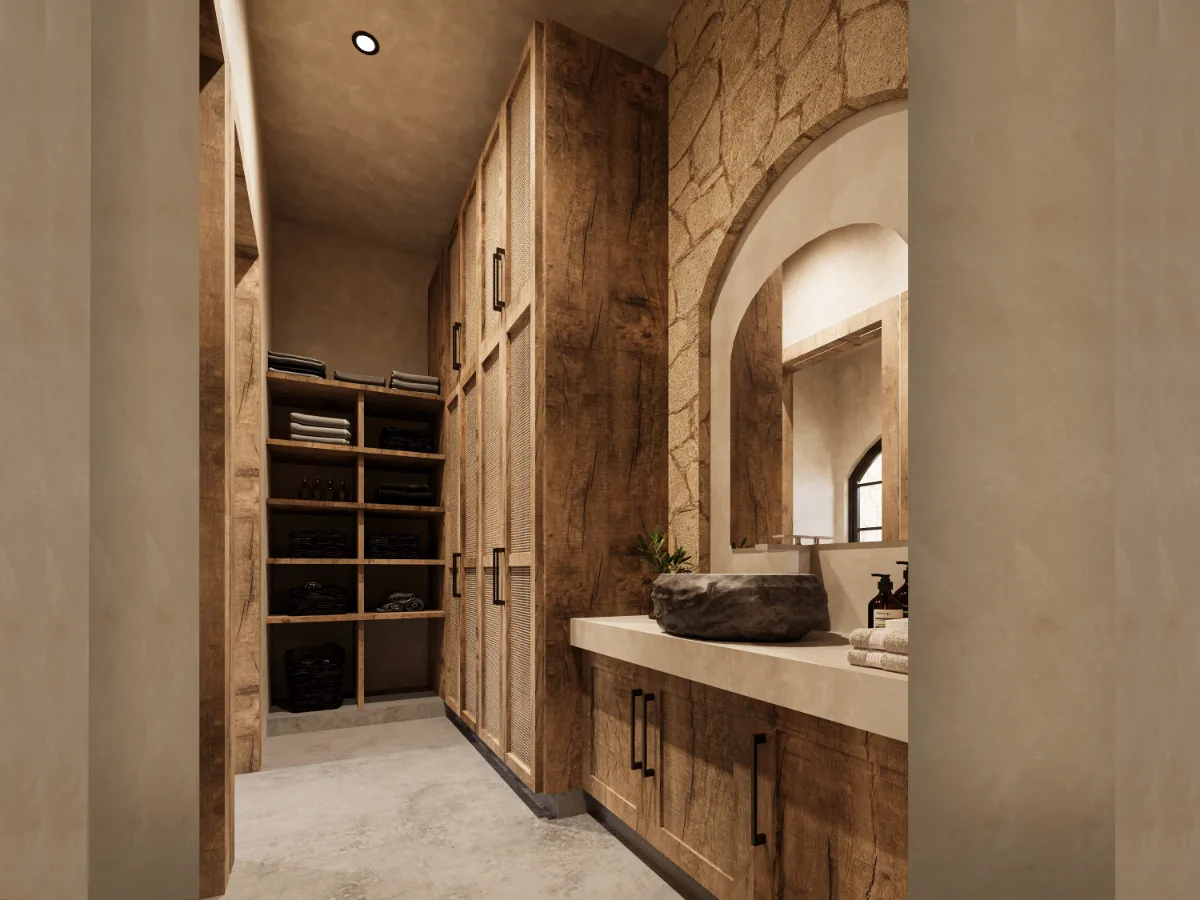
Nothing here is a stock image, a mood board or a house from another country. These are real Riviera Maya houses and projects: the double-height living room above, the kitchen with the steel hood, the rooftop palapa with the swings, the stone facade from the street. Houses like these are for sale here right now.
And that is the point: most Mexicans who write to us from abroad assume this level of design belongs to a resort development or to a budget they do not have. Very often it does not. It belongs to a specific developer, in a specific area, at a price that surprises people, and with the advantage of taking the deed in your own name with no trust. The only way we can point you there is knowing what you want.


Start with your documents,
not with the listings
Answer the questionnaire and tell us where you live and which Mexican documents you have. We will tell you whether you buy by direct deed or as a foreign buyer, what is missing to reach the notary without friction, whether a mortgage is worth measuring, and which areas are realistic for your number. If the honest answer is to wait, we will tell you that too.
